

South Africa truly does shine bright as a world-class African country as we continue to rollout, connect, and develop our infrastructure. While being connected and having access to the internet is fast becoming a basic human need, there are those that will be without access for a while — that's not to say that just because there is no fibre at your door, that it is not available to you.
As we continue to develop at an admirable rate on all fronts, having fibre is a great advantage for many of us, as we can now work and play with little hindrance at high speeds all day and all night. There are, however, a few factors to take into consideration as we get connected — to name but a few: security, privacy, "what's the right fibre for me?", dedicated or broadband, service provider SLAs, price and, of course, speed.
Where to begin
The pricing of fibre across SA differs from area to area, company to company and SP to SP — sometimes making it challenging to decide what will be best for you, be it for FTTH (Fibre to the Home), Business Broadband or Dedicated Fibre. There are a few considerations that need to be taken into account when establishing what's truly best for your business's unique needs.
Above all should be the SLA (Service Level Agreement):
- What happens when it goes down? Your SLA should stipulate guaranteed uptime and downtime redundancy plans.
- How uncapped is uncapped? Providers should disclose their cap or Fair Usage Policy, with a breakdown of throttling based on usage.
- What if a technician is required on-site? The SLA may or may not cover call-outs, labour hours and network management costs, depending on your package.
Given these considerations, it's worth comparing a few different service providers and package offerings before committing contractually to any one provider.
Getting bang for your buck
It's important to understand your own needs, and how capable business fibre is, before assuming a dedicated high-speed line is necessary just because you have a fast FTTH line at home. Business fibre is considerably more expensive than FTTH, simply because of the guarantees that come with it — high speeds, minimum downtime, and service turnaround times.
Who's using it, and for what? Some considerations:
- The number of users and devices being connected
- Whether you have security and accessibility policies managing your network
- Whether it will be used for telecommunications
- Off-site and on-site servers
- Video conference users
- The type of data you're sharing, downloading and uploading
A 10-person business sending emails, using phones and storing data in the cloud will run just fine on a 20–50Mbps line. An enterprise running VPNs, connecting to overseas servers and moving large files throughout the day needs a dedicated business fibre line for both privacy and security, plus network management tools that enforce endpoint, user and device restrictions.
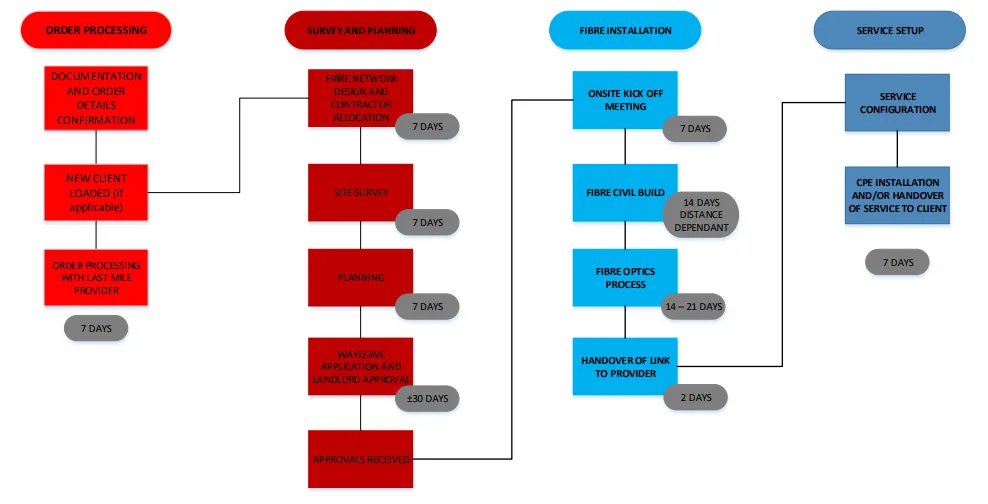
How long will it take to get fibre?
Once you've established whether you need broadband or dedicated business fibre, the timeline from order to activation can span anywhere from a few days to several weeks — this usually depends on dealing with municipalities for wayleaves to trench and lay the fibre.